
Laser for Redness & Broken Capillaries: My Candid Review
Updated on April 6, 2026
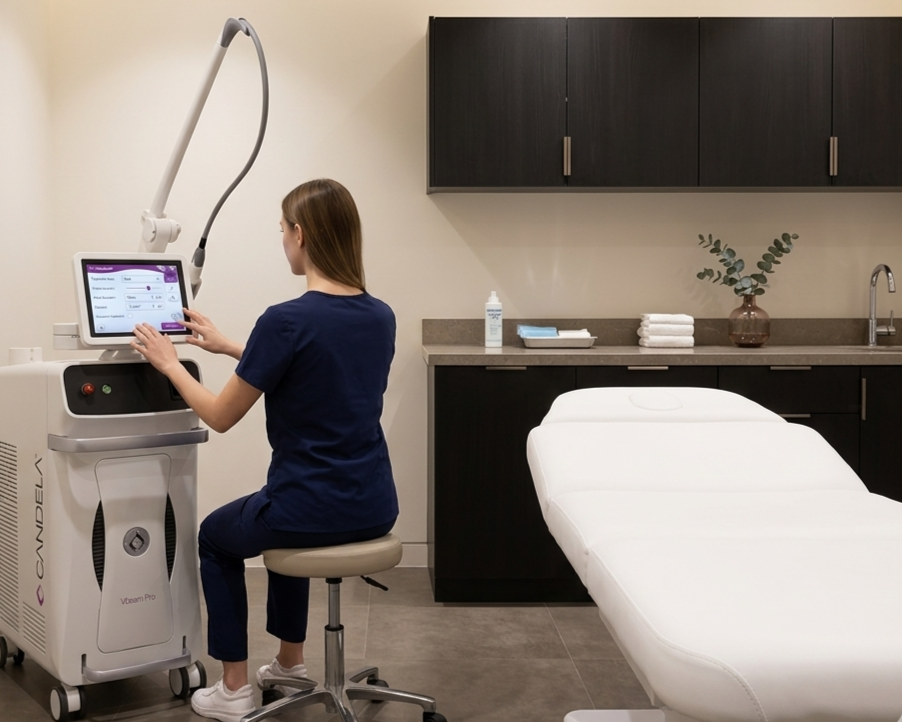
I’ve been sitting on this post for a few weeks because I wanted to give it enough time to actually have something useful to say. I’ve now had two vascular laser treatments, I’ve seen real results, and I have thoughts.
Grab a coffee.
A Little Background
I’ve dealt with facial redness most of my adult life. Redness across my cheeks, tiny broken capillaries around my nose and chin, the kind of flushed complexion that makes people ask if you’ve been outside in the cold, or worse, drinking!😄
For years I managed it with makeup. Foundation, colour corrector, the works. It was fine. It was my routine. And then somewhere in my 50s I had the very reasonable thought: I don’t want to do this anymore. I want to run to the grocery store without looking like I’m recovering from something.
My redness has never improved on its own; it’s actually gotten worse with age. My skin type (fair, sensitive, reactive) is naturally prone to it, and that doesn’t magically improve over time. At some point, I stopped waiting for it to sort itself out and started doing actual research.
I read a lot of articles. I consulted with my dermatologist. And eventually I decided to try a vascular laser treatment.
What Is a Vascular Laser Treatment, Exactly?
Vascular laser treatments targets the blood vessels beneath the skin’s surface. The laser emits a specific wavelength of light that is absorbed by the hemoglobin in those vessels, which essentially causes them to break down and get reabsorbed by the body over time. The surrounding skin is not damaged in the process. It’s precise, targeted, and specifically designed for things like redness, rosacea, spider veins, and broken capillaries on the face.
This is not the same as IPL (Intense Pulsed Light), though they’re often lumped together in the same conversation. IPL uses a broad spectrum of light and treats a wider range of concerns. Vascular laser is more targeted. If you’re going in for a consult, it’s worth asking which one they’re recommending and why.
My areas of concern were my cheeks, around my nostrils, and my chin; both underlying redness and the broken capillaries. As I understand it, vascular laser treatments are also used for spider angiomas and cherry angiomas, port-wine stains and some birthmarks (ones with a vascular component to them), and some scars with lingering redness (surgical or acne scars). Although not my focus, I also had a small cherry angioma on my face that got treated with the laser, and it took it away after the first treatment.
What Does this Laser Treatment Actually Feel Like?
It’s not that bad. It feels like a quick series of sharp pin pricks across the treatment area. Very fast, very localized. Slightly spicier around the nostril area, my eyes did water a bit. It’s over in seconds though.
Important to note, your skin is not being broken or cut during this laser treatment, it just feels like it’s being pinged repeatedly in a very focused way. It’s not pleasant, but easily manageable.
No numbing cream was required or offered, which tells you something about the intensity level. For added context, I had microneedling with RF last year, and that was a completely different experience. You can read that post here. The vascular laser treatment is nowhere near that level of discomfort.
The entire appointment, from the time I sat in the chair to the time I walked out, was about 45 minutes.
The Downtime: Here’s The Truth
Here’s where I want to be really straightforward with you, because the “minimal downtime” framing that clinics use doesn’t tell the whole story.
Most people who have this laser treatment will be red for at least 24 hours. Think: sunburn, that’s the standard experience.
I am not most people, skin-reactivity-wise.
After my first treatment, I was red and visibly swollen for a full 48 hours. From what I understand (and what my clinician confirmed), this is the more extreme end of the reaction spectrum; it does happen, but it’s not the majority experience. If your skin is sensitive and reactive, just know this is possible. Plan accordingly. Do not book this treatment less than 3 days before anything important.
Bruising is also on the table. I had two small bruises, each about the size of a freckle. They were gone within four days. The nature of the laser (it’s targeting tiny vessels very precisely) means the bruising tends to be small and concentrated. That said, I’ve seen photos of more significant bruising than what I experienced. Whether that’s down to more aggressive settings, individual skin response, or clinician technique, I genuinely don’t know. I’ll just say: don’t be surprised if it happens, and don’t be alarmed if it does.
A few other, important things to know:
- Stay out of the sun, both before and after the treatment.
- Wear SPF every day, not just on treatment days (you should be doing this anyway).
- Reputable clinics will not perform this treatment in summer months, and they’ll want to see that your skin has had no sun exposure going in. No colour in the skin is the goal before treatment. Even a fake-tan is not allowed.
- Avoid anything that causes heat or flushing (hot showers, exercise, saunas, drinking, spicy food) for at least 24 to 48 hours after.
The Results: What I’m Actually Seeing
Even after one session, I noticed an improvement in the overall redness of my complexion. The broken capillaries looked faded. The general red flush was much calmer.
The catch is that this doesn’t happen overnight. Results reveal themselves gradually over several weeks as your body processes and reabsorbs the damaged vessels. I started noticing a difference a couple of weeks after my first treatment, but it wasn’t until my six-week follow-up (when we reviewed the before and after photos side by side) that I could really see how much had changed. Photos don’t lie. My skin tone was meaningfully more even.
I’ve since had my second treatment, about four weeks ago, and six weeks after the first. Every morning I look in the mirror and my skin tone looks a little bit better than it did the morning before. That sounds like an exaggeration; it isn’t. It’s a slow, steady improvement. I feel like the 5 week mark is where you are seeing the full result of the treatment; it’s probably not going to improve much more than that.
I’m currently weighing whether to do a third treatment now, or wait and do a touch-up in the fall. That’s the other thing to know: these treatments are recommended to be spaced at least six weeks apart.
Is It Worth It?
For me, yes. But let me be specific about what I mean by that, because “worth it” means different things to different people.
My goal was never to look younger, that’s not what this was about. My goal was to have a more even skin tone so I could wear less makeup and feel like a comfortable, refreshed version of myself.
On that measure, this treatment is delivering. I’m reaching for less foundation. The redness that used to require daily concealment is calmer and more manageable. And that’s exactly what I was hoping for.
A few things I’d suggest you to consider before booking:
- Go to a reputable clinic with experienced clinicians. This is a laser. The person operating it should know what they’re doing. Ask questions. Ask about their experience with your skin type specifically. My clinician used more aggressive settings on my second treatment because she had assessed how my skin responded to the first; that kind of individualized approach matters.
- Manage your expectations around downtime. If you have sensitive skin, be realistic. Plan to look a bit rough for 48 hours. Work from home if you can.
- Patience is genuinely required. If you expect to walk out looking different, you’ll be disappointed. The results come in the weeks following treatment, not the days.
- This is likely a multi-session commitment. Two sessions has given me solid results. Three will probably get me to where I’m hoping to be. And occasional maintenance treatments will probably be part of my routine going forward.
One More Thing I Want to Add
If you’ve been tolerating skin concerns for years because you assumed nothing could be done, or because the idea of a laser sounded scary, I get it. I waited a long time on this. But the consultation process was straightforward, the treatment itself was very manageable, and the results have been genuinely worth the mild drama of the recovery.
Talk to your dermatologist. Do your research. Choose your clinic carefully. And if your skin is on the sensitive side, just give yourself a couple of low-key days afterward. Chipmunk cheeks are not a great look for meetings.
Curious about other in-clinic treatments I’ve tried? Read my honest review of microneedling with RF here: Is Microneedling Worth It?
Here’s another common resource I use for researching skin treatments : The Tweakments Guide. They’re based in the UK, however I use the guide more for information and perspective rather than referrals.
Share this post with a friend:
Copy LinkLink copied!